
Introduction
Often, factory managers talk about how manufacturing floors have changed over the years. They mention that earlier, whenever a machine suddenly stopped working, the first reaction was usually panic. Production would slow down, technicians would rush to inspect the equipment, and everyone would try to figure out how long operations would be affected.
With time, everything has changed and has become much calmer.
Machines themselves can send warnings before a breakdown happens. Maintenance teams often know something is wrong before the production line actually stops. Managers can check production performance on a dashboard instead of waiting for someone to manually prepare reports.
That is the kind of change IoT is bringing into manufacturing.
And honestly, this shift did not happen overnight.
In the beginning, many manufacturers couldn’t accept this concept of connected technologies. Some of them assumed IoT would be beneficial for big enterprises as they don’t have budget issues. Others felt the technology sounded complicated to implement inside traditional factory environments.
But gradually, businesses began to notice something important. Well, in reality, IoT was solving real operational problems.
Not theoretical problems are discussed in meetings. Rather, actual day-to-day issues factories struggle with constantly.
Things like:
- unplanned downtime,
- delayed maintenance,
- inventory confusion,
- rising operational costs,
- energy waste,
- and a lack of visibility across production lines.
That is one reason IoT adoption has grown so quickly in manufacturing over the last few years.
And from the way the industry is moving, connected factories will probably become far more common in the future.
What Is IoT In Manufacturing?
A lot of people hear the term “IoT” and immediately think it sounds extremely technical.
But in manufacturing, the idea is actually pretty straightforward.
IoT basically means machines, systems, sensors, and devices are connected. This way, they can share information automatically. Years ago, manual monitoring was the only method that factories could rely on. Workers often had to inspect machines physically to understand whether something was wrong. Sometimes problems were only discovered after production was already affected.
Connected systems change that completely.
For example, a machine can automatically report unusual vibration, increasing temperature, pressure fluctuations, or sudden energy spikes.
Instead of waiting for equipment failure, teams can respond much earlier.
Common examples of IoT in manufacturing
1. Sensors attached to production equipment
IoT sensors are mainly installed on machines and production equipment. The purpose is to collect data like temperature, vibration, pressure, and operating speed. Well, acquiring this type of data is necessary as manufacturers can understand their equipment and its performance.
2. Smart inventory tracking systems
Another common example is smart inventory tracking systems. These types of systems utilize devices like RFID tags, barcode scanners, and connected sensors. Thus, monitoring inventory levels automatically becomes an easy task.
3. Automated maintenance alerts
It’s easy to detect unusual operating conditions with the help of IoT-based equipment. This way, manufacturers can schedule maintenance when it’s needed. Expanding the life span of all equipment becomes simpler.
4. Real-time production dashboards
With such devices, a manufacturing firm can extract data from machines and connected systems. A centralized displays all the collected real-time data. Managers and supervisors can monitor production performance, equipment utilization, and output levels in real time.
5. Connected Warehouse Systems
Warehouse operations have leveled up with the help of IoT sensors, smart shelves, and some tracking systems. This access to real-time information has also ensured proper decision-making and streamlined workflows.
Why manufacturers are investing more in IoT
1. Downtime costs continue rising
A small period of downtime due to an unplanned equipment failure is never acceptable. But without prior tracking such incidents may happen. But IoT can bring some relief as it provides early warnings about possible equipment issues.
2. Production pressure is increasing
Manufacturers can never ignore the pressure they feel when it comes to manufacturing more and more high-quality products. At the same time, deadlines can’t be missed. They need IoT to improve their overall productivity to meet the growing expectations of the customers.
3. Supply chains are less predictable
Dealing with the complex problems of supply chains has become more difficult. Issues like transportation delays and shortage of raw materials can be managed well if IoT is utilized to gain a real-time view of inventory and other activities.
4. Companies need real-time operational visibility
Handling operational data is another challenge that most manufacturing farms have been facing for years. However, IoT can simplify this as it connects equipment and systems. Thus, tracking operations in real time is hassle-free.
5. Energy efficiency has become more important
Manufacturers also can’t avoid rising energy costs. At the same time, right action also can’t be taken without accurate data. The energy monitoring system backed by AI power can provide detailed insights. This can certainly help manufacturers optimize the usage of energy.
What is the future of IoT manufacturing?
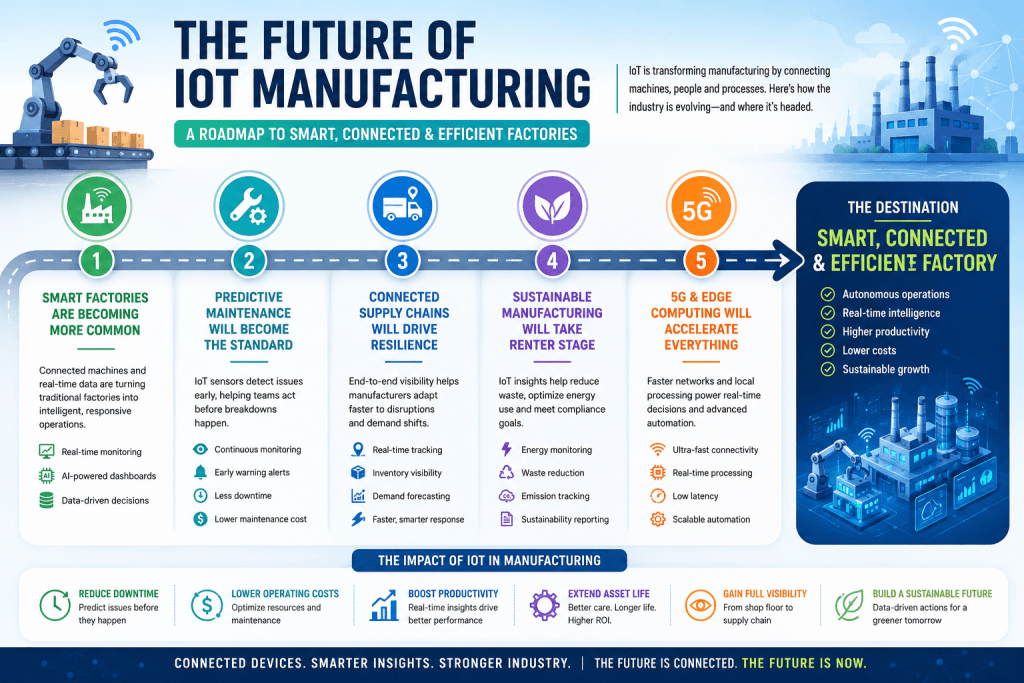
1. Smart factories are becoming more common
There was a time when “smart factories” sounded like something people would only discuss at technology conferences. Now the concept feels much more real. A smart factory is basically a manufacturing environment where machines, software systems, sensors, and operational data work together continuously.
What is more interesting here is that everything becomes more connected rather than operating separately.
For example:
- Sending live performance updates
- Issuing automatic alerts from maintenance systems
- Digital dashboards to monitor operations
Features commonly seen in smart factories:
- Connected production equipment
- Automated production monitoring
- Real-time operational dashboards
- Predictive maintenance systems
- Smart inventory management
- AI-powered analytics
Benefits manufacturers are seeing:
- Faster response to production issues
- Better operational visibility
- Reduced downtime
- Improved workflow efficiency
- Less manual supervision
- Better production consistency
What is interesting is that most companies are not transforming everything at once. Usually, the process happens gradually. A manufacturer may first connect to a few critical machines, then expand IoT systems slowly over time as they start seeing operational benefits.
2. Predictive maintenance will become more important
Unexpected equipment failure is still one of the biggest frustrations in manufacturing. And honestly, it affects far more than just one machine. A breakdown can interrupt production schedules, delay deliveries, increase labor pressure, and create expensive repair situations. Traditionally, companies handled maintenance in two common ways:
- fixing equipment after failure,
- or servicing machines on fixed schedules.
The problem is that both methods can become inefficient. This is where predictive maintenance is making such a big difference. Connected sensors can monitor machine conditions continuously and identify warning signs before serious failures happen.
Sensors can monitor things like:
- Temperature
- Pressure
- Vibration
- Noise patterns
- Energy consumption
If something unusual appears, maintenance teams receive alerts early.
That gives companies time to address smaller issues before production stops completely.
Benefits of predictive maintenance include:
- Reduced equipment downtime
- Lower repair expenses
- Better maintenance scheduling
- Longer equipment lifespan
- Improved production reliability
3. Connected supply chains will improve visibility
The last few years showed manufacturers how important supply chain visibility really is. Many businesses struggled because they lacked accurate, real-time information about:
- shipments,
- inventory levels,
- supplier delays,
- and warehouse operations.
IoT can help improve that visibility significantly. Connected systems can continuously track products, shipments, and storage conditions.
IoT applications in supply chain management:
- Shipment tracking
- Smart inventory monitoring
- Warehouse condition monitoring
- Real-time delivery updates
- Environmental tracking during transportation
Benefits manufacturers may see:
- Better inventory planning
- Faster response to disruptions
- Reduced product loss
- Improved logistics visibility
- Better supplier coordination
For industries dealing with sensitive products, this level of monitoring can become extremely valuable.
4. Sustainability will influence future manufacturing
Sustainability is becoming a much bigger topic across manufacturing industries now. Customers, regulators, and investors are all paying more attention to environmental impact than before. That means manufacturers are trying harder to:
- reduce waste,
- improve energy efficiency,
- lower emissions,
- and use resources more responsibly.
IoT can support many of these goals.
How IoT supports sustainability:
- Monitoring electricity consumption
- Reducing unnecessary machine idle time
- Tracking water usage
- Improving equipment efficiency
- Identifying material waste
Long-term benefits for manufacturers:
- Lower operational costs
- Better resource management
- Reduced environmental impact
- Easier sustainability reporting
- Improved regulatory compliance
Many manufacturers now see sustainability and smart manufacturing as closely connected rather than separate initiatives.
5. 5G and edge computing will accelerate IoT growth
The future of industrial IoT will also depend heavily on technologies like 5G and edge computing. Even though these technologies operate mostly behind the scenes, they are important because they enable connected systems to process information much faster.
Benefits of 5G in manufacturing:
- Faster communication between devices
- Lower network delays
- Better support for automation
- More reliable connectivity
Benefits of edge computing:
- Faster data processing
- Reduced cloud dependency
- Real-time operational decisions
- Improved system performance
Most factory workers may never directly notice these technologies, but they will quietly support many future manufacturing operations.
What the future of manufacturing could look like
Clearly, it’s more data-driven and, of course, more connected.
Yes, in the coming days, factories will certainly become smarter, faster, and also more automated.
Future manufacturing environments may rely heavily on:
- Analytics that are AI-powered
- Predictive maintenance,
- connected machines,
- and real-time production monitoring.
Companies that invest in connected technologies early may gain a stronger operational advantage later.
Conclusion
The future of IoT manufacturing is not really about replacing people with machines. It is more about helping factories operate more intelligently and giving teams better visibility into operations.
Connected systems are already helping manufacturers:
- reduce downtime,
- improve operational awareness,
- strengthen workplace safety,
- optimize production,
- and make faster decisions.
And honestly, many of these changes are already happening. Technology will continue to evolve.
Author Bio:

Raja Sarkar is a technology leader and IoT strategist with extensive experience helping organizations leverage connected technologies to improve operational efficiency, visibility, and business performance. As Director of OUM Technology Solutions, he works closely with manufacturers, healthcare providers, supply chain organizations, and industrial enterprises to implement IoT-driven solutions that enable smarter decision-making and digital transformation.
With a deep understanding of Industrial IoT (IIoT), smart manufacturing, automation, and data-driven operations, Raja regularly shares insights on emerging technologies, connected systems, predictive maintenance, supply chain visibility, and the future of digital enterprises. His articles focus on translating complex technology trends into practical strategies that help businesses improve productivity, reduce operational costs, and prepare for the future of Industry 4.0.