For centuries, agriculture has faced one of its biggest challenges — pests and diseases. These threats continue to devastate crops, reduce yields, and endanger global food security. The Food and Agriculture Organization (FAO) estimates that pests and plant diseases account for 20–40% of total crop losses each year. This way, they create a massive impact on both farmers’ livelihoods and the global food supply chain.
Traditionally, pest and disease management have been more reactive than preventive. Farmers often respond only after visible damage appears, when it’s already too late. Such late interventions can lead to high economic losses, excessive use of chemical pesticides, and even long-term harm to the environment.
That’s where the Internet of Things (IoT) becomes relevant. By enabling real-time monitoring, early detection, and predictive insights, this technology transforms how farmers protect their crops. But how exactly does it work, and how does it provide smarter farming solutions?
What is IoT in Agriculture?
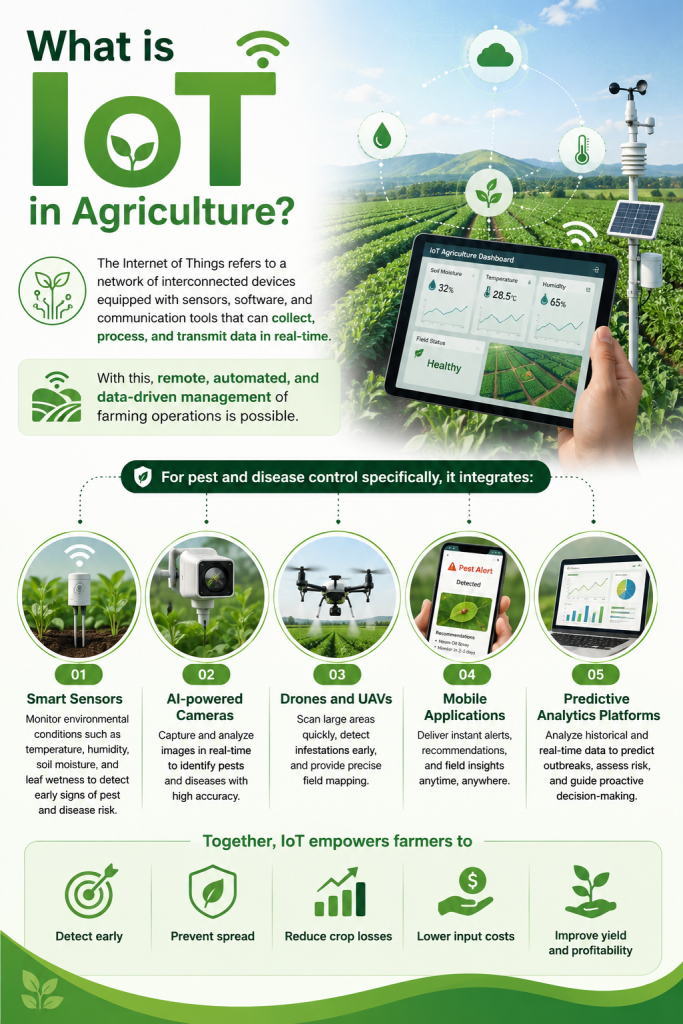
The Internet of Things refers to a network of interconnected devices equipped with sensors, software, and communication tools that can collect, process, and transmit data in real-time. With this, remote, automated, and data-driven management of farming operations is possible.
For pest and disease control specifically, it integrates:
- Smart sensors
- AI-powered cameras
- Drones and UAVs
- Mobile applications
- Predictive analytics platforms
These tools allow for continuous observation and rapid response. This way, they dramatically reduce the reliance on manual labor and subjective judgment.
How IoT Identifies Pests and Plant Diseases?
1. Environmental Monitoring Sensors
Such sensors can be placed throughout the field or greenhouse to monitor:
- Air and soil temperature
- Humidity levels
- Soil moisture content
- Leaf wetness
- Light intensity
Its Importance:
Many pests and diseases are highly dependent on microclimatic conditions. For example, powdery mildew thrives in humid environments, and aphids multiply rapidly when the temperature rises. These sensors can detect such conditions and trigger early warnings before an infestation occurs.
Example:
If humidity exceeds 85% for 12 hours in a greenhouse, an alert is generated recommending preventive fungicide spraying.
2. Computer Vision & AI-Powered Imaging
High-resolution cameras are generally installed in the field or mounted on drones. They use image recognition algorithms to detect:
- Color changes in leaves
- Wilting or curling
- Spots, lesions, or mildew
- Presence of insects on plant surfaces
Also, machine learning models are trained on thousands of disease and pest images. They enable them to accurately diagnose specific problems in real time.
Example:
AI detects leaf discoloration on a tomato plant and identifies it as early blight with 94% confidence. It automatically logs the affected area and suggests a treatment.
3. Drones and Aerial Imaging
Drones equipped with multispectral cameras, thermal sensors, and infrared imaging can survey large areas quickly and provide:
- Heat maps of stressed crop regions
- Early signs of infestation or disease spread
- Precise GPS coordinates of affected zones
This helps farmers avoid unnecessary spraying by targeting only the affected areas, thereby reducing costs and pesticide use.
4. Smart Traps and Pheromone Monitoring Devices
These IoT devices use pheromones or light to attract specific insects (e.g., moths, fruit flies), then:
- Count the captured pests using optical or pressure sensors
- Analyze movement behavior
- Send real-time data to cloud dashboards
They help track pest population trends and suggest the optimal time for intervention, preventing outbreak escalation.
5. Mobile Applications and Cloud Analytics
Farmers can receive:
- Real-time alerts
- Visual diagnostics
- Geo-tagged reports
- Pest risk indices
- Localized weather-triggered warnings
Mobile apps often work in tandem with cloud platforms that aggregate and analyze all field data to provide personalized recommendations.
Example:
A cloud-based model predicts an outbreak of rice blast disease in the next 48 hours based on humidity, rainfall, and temperature patterns.
Real-World Examples
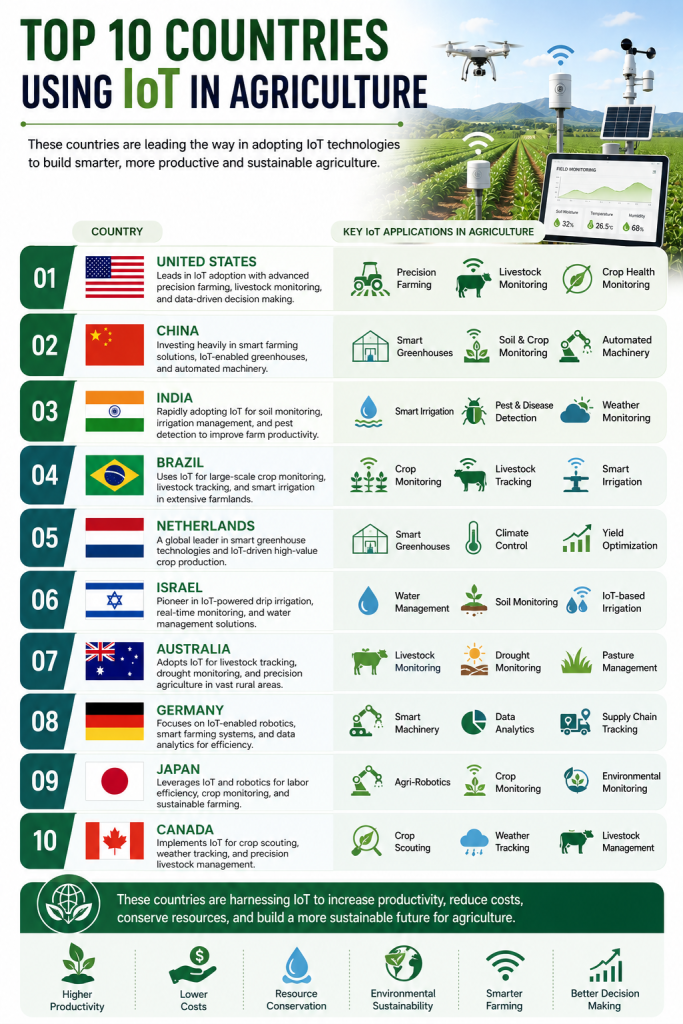
1. United States
The United States is one of the global leaders in precision agriculture and smart farming technologies. According to the USDA, around 27% of U.S. farms use precision agriculture tools, while adoption exceeds 50% in major grain-producing states. Technologies such as GPS-guided tractors, automated irrigation systems, drones, and IoT sensors are widely used for crop monitoring and livestock management. Large crop farms reported nearly 68% usage of yield monitoring and soil mapping technologies.
Source: https://www.ers.usda.gov/data-products/charts-of-note/chart-detail
2. China
China is heavily investing in smart agriculture to strengthen food security and improve farming efficiency. The country’s Agriculture IoT market generated approximately USD 3.29 billion in 2024 and is projected to reach USD 5.59 billion by 2030. China’s government has also launched a national smart farming plan focused on integrating AI, IoT, GPS, and agricultural big data platforms to modernize farming operations.
Source: https://www.grandviewresearch.com/horizon/outlook/agriculture-iot-market/china
3. India
India is rapidly adopting IoT technologies to address irrigation inefficiency, pest outbreaks, and climate-related farming challenges. The Indian smart irrigation market reached approximately USD 167.3 million in 2025 and is expected to grow to USD 548.8 million by 2034 at a CAGR of 13.68%. IoT-based irrigation systems in India help farmers reduce water wastage and improve crop productivity through real-time monitoring and automation.
Source: https://www.imarcgroup.com/india-smart-irrigation-market
4. Brazil
Brazil uses IoT technologies extensively in large-scale agriculture, especially in soybean, sugarcane, and livestock farming. Smart monitoring systems, satellite-connected sensors, and automated irrigation technologies help improve productivity across massive agricultural lands. Brazil is also one of the world’s largest adopters of precision farming technologies for export-driven agriculture.
5. Netherlands
The Netherlands is recognized globally for its highly advanced greenhouse farming systems powered by IoT. Dutch farmers use smart climate control systems, humidity sensors, and AI-driven crop monitoring technologies to maximize production while minimizing water and land use. The country has become one of the world’s top agricultural exporters despite limited farmland availability.
6. Israel
Israel is a pioneer in IoT-powered drip irrigation and water-efficient farming technologies. Due to water scarcity, Israeli agriculture relies heavily on real-time soil moisture monitoring and automated irrigation systems. Smart irrigation technologies can reduce agricultural water usage significantly while improving crop quality and yield.
7. Australia
Australia uses IoT primarily for livestock monitoring, drought management, and remote farm operations. Smart collars, GPS tracking systems, and environmental sensors help farmers monitor cattle health and pasture conditions across vast rural landscapes. IoT-driven drought monitoring is particularly important because of Australia’s harsh climate and water scarcity challenges.
8. Germany
Germany focuses on Industry 4.0-driven agriculture using connected machinery, agricultural robotics, and smart analytics platforms. IoT-enabled farming equipment improves operational efficiency, precision planting, and automated harvesting. German farms are increasingly adopting data-driven agriculture to reduce labor dependency and increase sustainability.
9. Japan
Japan combines IoT with robotics and AI to solve labor shortages in agriculture. Smart greenhouses, automated crop monitoring systems, and agricultural robots are widely used to improve farming efficiency. Japan’s smart farming initiatives focus heavily on automation because of its aging farming population and limited agricultural workforce.
10. Canada
Canada uses IoT technologies for precision crop scouting, livestock management, and climate monitoring. Farmers rely on connected sensors and real-time weather tracking systems to improve productivity and reduce operational risks caused by changing environmental conditions. IoT-based farming is particularly valuable in Canada’s large-scale grain and livestock sectors.
Key Benefits of IoT in Pest and Disease Management
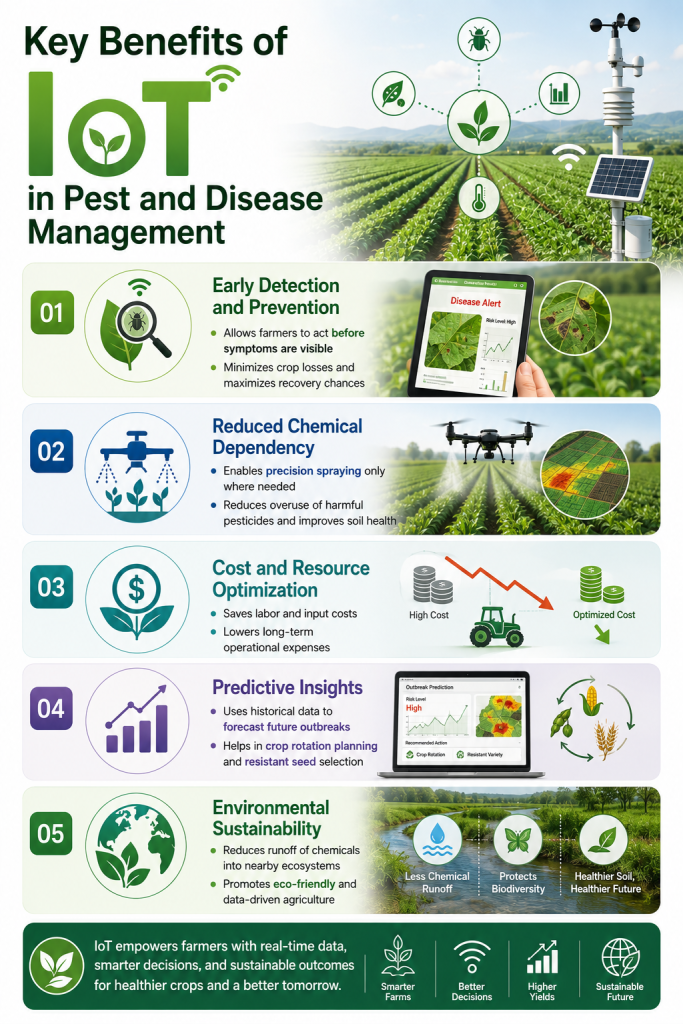
1. Early Detection and Prevention
- Allows farmers to act before symptoms are visible
- Minimizes crop losses and maximizes recovery chances
2. Reduced Chemical Dependency
- Enables precision spraying only where needed
- Reduces overuse of harmful pesticides and improves soil health
3. Cost and Resource Optimization
- Saves labor and input costs
- Lowers long-term operational expenses
4. Predictive Insights
- Uses historical data to forecast future outbreaks
- Helps in crop rotation planning and resistant seed selection
5. Environmental Sustainability
- Reduces runoff of chemicals into nearby ecosystems
- Promotes eco-friendly and data-driven agriculture
Real-World Examples: Top 10 Countries Using IoT in Agriculture
Key Challenges to Adoption
1. High Initial Investment
Such devices, especially drones and AI systems, can be expensive for smallholder farmers without subsidies. The upfront cost of precision agriculture technologies — including sensors, automated machinery, and integrated software platforms — often places them out of reach for small and marginal farmers who operate on thin profit margins. Government intervention through subsidies, cooperative ownership models, or lease-based access programs can help bridge this financial gap and democratize access to modern agricultural tools.
2. Limited Connectivity
Remote and rural areas may lack the internet or cellular infrastructure required to support real-time IoT functionality. Inconsistent power supply further compounds this problem, making it difficult to run and maintain connected devices continuously. Expanding rural broadband, investing in satellite-based internet solutions, and developing offline-capable edge computing systems are critical steps toward making smart farming viable in underserved regions.
3. Knowledge Gaps
Farmers may not be fully trained to operate or interpret such systems effectively, requiring investment in capacity building. Beyond basic operation, understanding data outputs, making evidence-based decisions from analytics dashboards, and troubleshooting technical issues demand a level of digital literacy that many rural farming communities have not yet had the opportunity to develop. Structured training programs, locally adapted user interfaces, and peer-learning networks can play a pivotal role in closing this gap.
4. Data Security and Privacy
As more data is collected, ensuring its secure handling and ethical usage becomes vital. Agricultural data — including crop yields, soil composition, and farm boundaries — holds significant commercial value and can be vulnerable to misuse by agribusinesses, insurers, or third-party vendors. Robust data governance frameworks, clear ownership rights for farmers, and transparent end-user agreements are essential to building trust and protecting the interests of those generating the data.
5. Interoperability and Standardization
The agricultural technology market is fragmented, with numerous vendors offering proprietary systems that often fail to communicate with one another. A farmer using one brand of soil sensors may find them incompatible with a different brand’s irrigation controller or farm management software. The absence of universal standards creates data silos, increases dependency on single vendors, and limits the scalability of precision farming solutions. Industry-wide standardization efforts and open-source platforms are needed to enable seamless integration across devices and services.
6. Environmental and Regulatory Constraints
The deployment of drones, autonomous vehicles, and AI-powered monitoring systems is subject to varying regulatory frameworks across regions. Airspace restrictions, data protection laws, and environmental compliance requirements can significantly slow adoption and add administrative burden. Policymakers must work in tandem with technology developers and farming communities to craft regulations that ensure safety and ethical standards without stifling innovation.
Conclusion
IoT-based pest and disease detection marks a powerful shift from reacting to problems to preventing them before they start. With the help of smart sensors, drones, machine learning, and cloud-powered insights, farmers can now monitor crops in real time, predict risks, and take quick, data-driven actions. In short, IoT transforms farmers from passive responders into proactive protectors of crop health and productivity.